Hand 05
Drum-Chart Stoneware
Marla Tregidga
Big pale jars with one nervous line running round them, like a needle that flinched.
On record
- Life
- b. 1943, Ohope — lives in Ohope, Bay of Plenty
- Origin
- Bay of Plenty
- Medium
- Coiled river-clay stoneware, ash and rutile glaze with iron slip, wood-fired to 1290°C
- School
- Drum-Chart Stoneware
- Works
- 02 in the collection
Influences
smoked-paper seismograph drums · river clay with pumice in it · manuka smoke · four-day wood firings · the flat light off Ohope Beach · salt fog on a cooling kiln
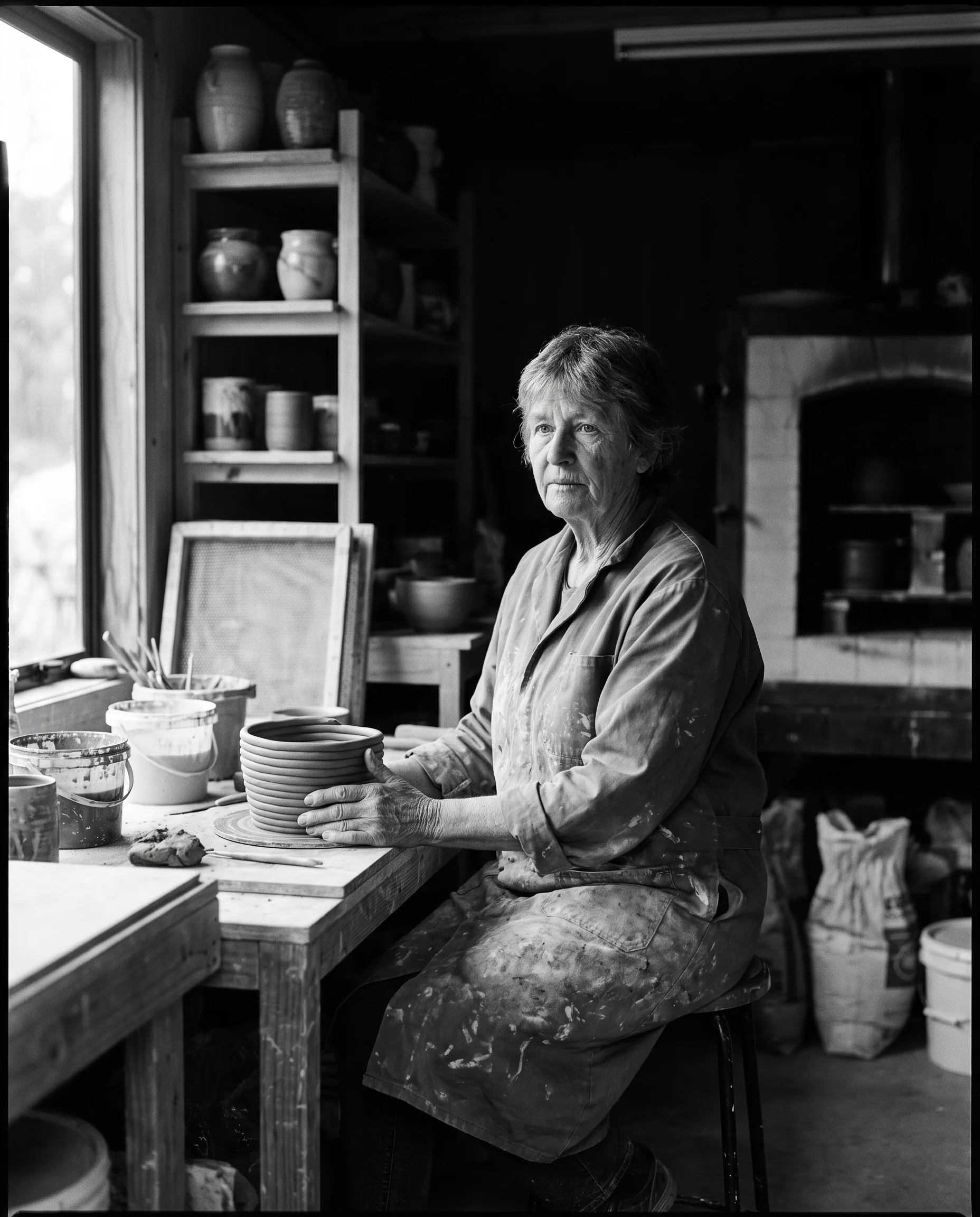
Tregidga was born at Ohope and spent thirty-one years as a recorder technician on a geothermal field inland from Kawerau, changing smoked paper on seismograph drums and inking the styli every second morning. She read those charts the way other people read weather: one thin line, hours of nothing, then a flinch. She began potting at forty-one in a shed behind the house because the clay in the river cutting up the road was free, and she has never bought a bag of clay in her life. She still has the exercise books from the drums.
The jars are coiled and paddled to about ninety centimetres, from river clay cut with a fifth of crushed pumice so the walls survive a four-day firing. She loads pine and manuka into a brick kiln built with her brother-in-law and sits up four nights with a thermos, writing temperatures in a school exercise book. In 1988 she pushed too hard through the first day and fourteen of nineteen pots bloated and split along the shoulder. Since then the first day is deliberately boring, and she says so as though it were a moral position.
Perhaps sixty jars exist. She breaks what she dislikes with a lump hammer, in front of people, without ceremony. She makes no lids, glazes nothing on the inside, and tells anyone who mentions flowers that a jar is not for flowers. She will not fire electric and will not ship: buyers drive to Ohope, are given tea in a mug she did not make, and carry the pot to the car themselves. Two dealers have stopped telephoning, which she reports as a result rather than a loss.
“One line round a pot is enough if it is the right line, and it is only right if my hand was tired when I drew it. I do not care much about glaze; the fire does the glaze and the fire is better at it than I am. People tell me the pots are quiet. They have never sat up with a kiln at three in the morning.”
The hand, as specified
- Substrate
- One large coiled stoneware jar, about ninety centimetres, shouldered high and faintly asymmetric, photographed alone on a concrete floor in a vertical three-by-four frame. Surface is dry and matte: pale ash green over rutile straw, iron slip pooling liver brown in the throat, a flank of kiln-flash apricot where flame licked, and an unglazed pumice-grey foot flecked with grit. Pinholes, crawl and one ash drip run down the belly. A single needle-thin incised line travels unbroken round the shoulder, wavering, closing slightly off from where it began. Cool overcast side light near 5200 kelvin, no reflections, a long soft shadow to the right. No ornament, no lid.
Selected exhibitions
- 1997One Line, Tired HandRangitaiki Kiln Hall
- 2008Not For FlowersKaramu Clay Store, Opotiki
- 2019Sixty JarsMOONFLUX
In the collection
02 works
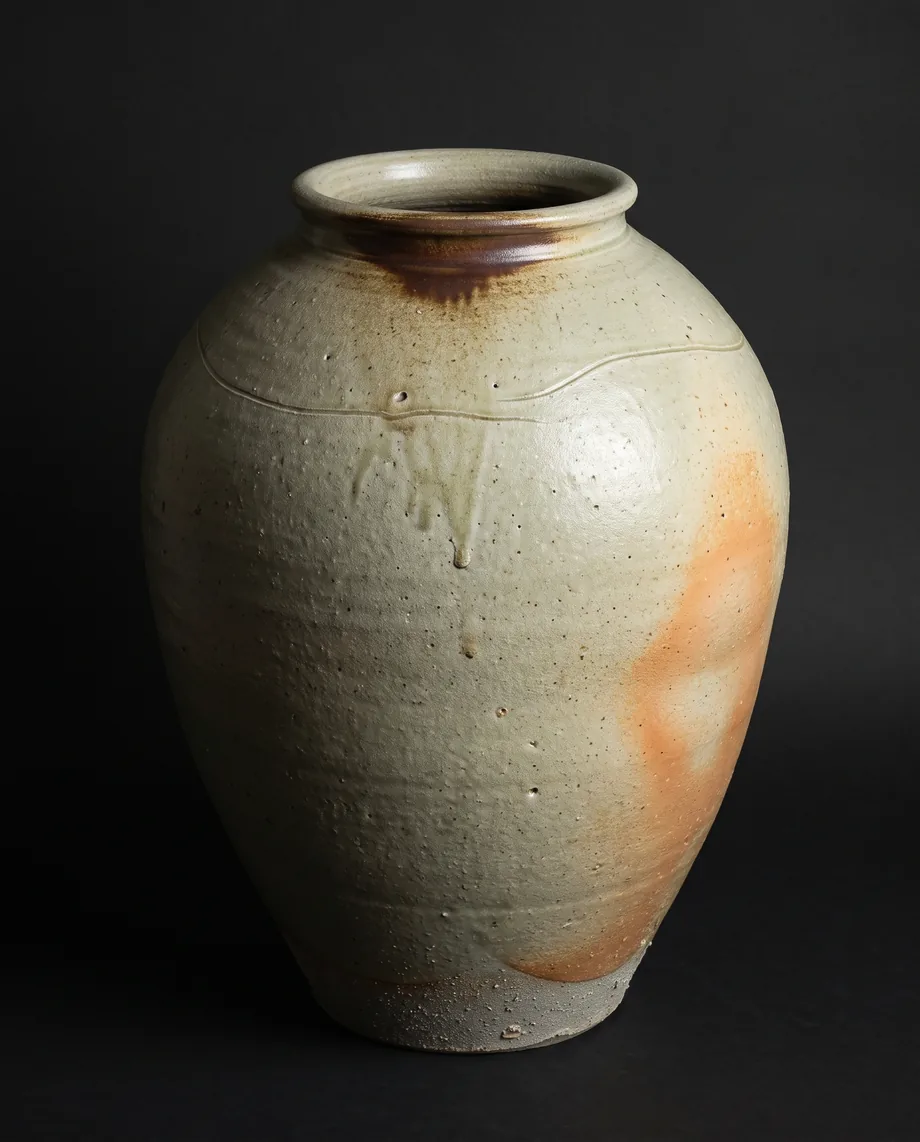
MF-009
92 × 41 × 41 cm
Ninety-Two Centimetres
Marla Tregidga · 2001
Coiled and paddled river clay with crushed pumice, ash and rutile glaze, iron slip, wood-fired to 1290°C over four days
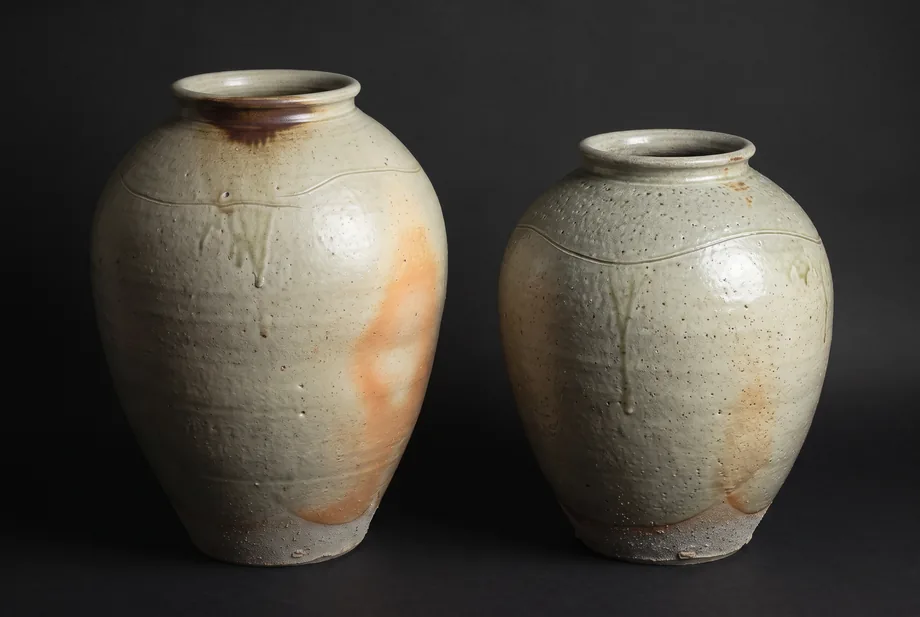
MF-010
79 × 124 × 63 cm overall, two jars
Firebox End
Marla Tregidga · 2006
Two coiled and paddled river-clay jars with crushed pumice, ash and rutile glaze, iron slip, wood-fired to 1290°C over four days, floor of the kiln beside the firebox