Hand 03
Silt Chart Adire
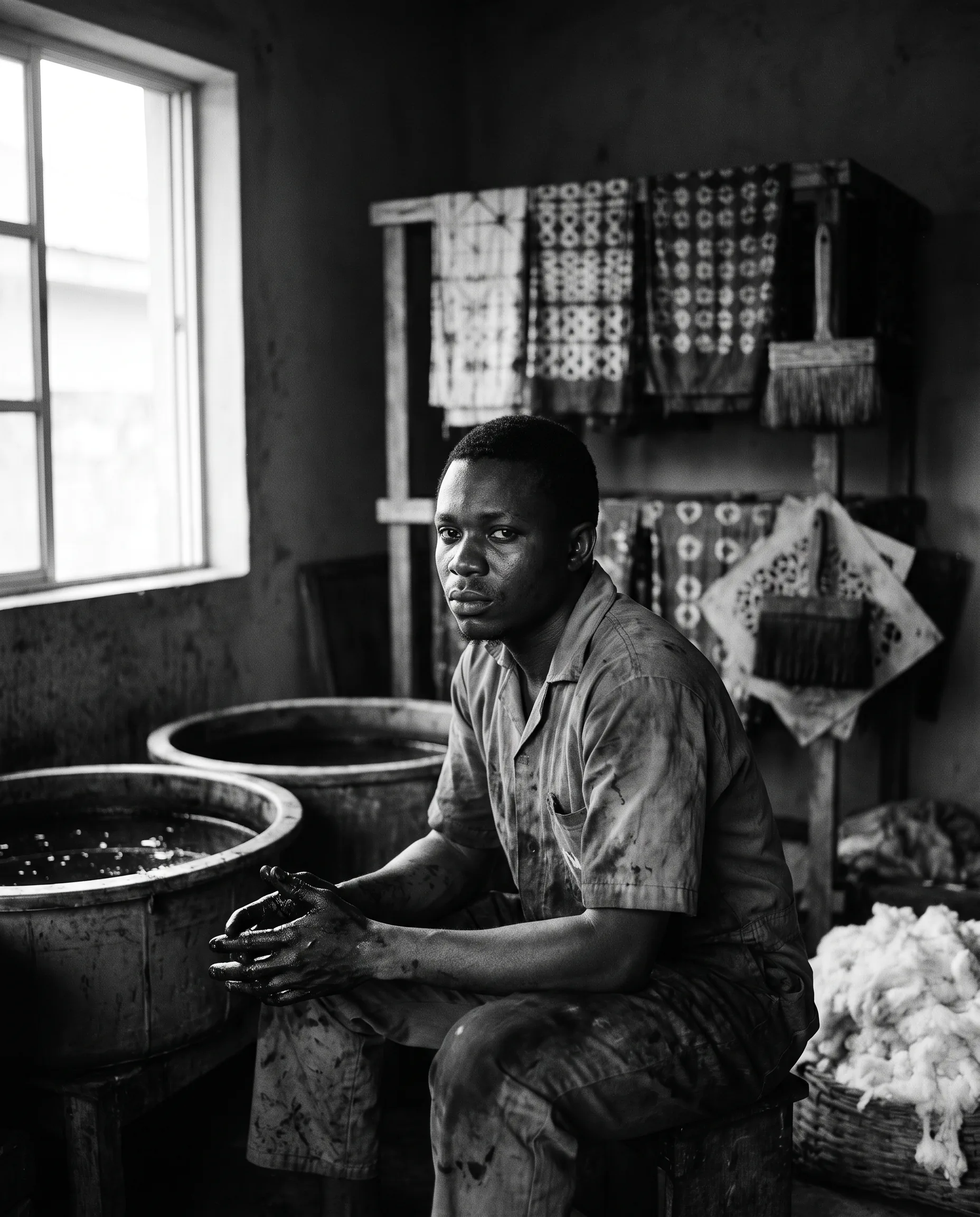
Bolaji Fagbemi
Every band of blue is a month of the Ogun River, measured.
On record
- Life
- b. 1994, Abeokuta — lives in Abeokuta and Berlin
- Origin
- Abeokuta
- Medium
- Cassava-paste resist and fermented indigo on hand-woven cotton strip cloth, stitched
- School
- Silt Chart Adire
- Works
- 02 in the collection
Influences
adire eleko resist · her grandmother's ash-lye recipe · hydrological stage-height logs · the Ogun in flood · narrow-loom strip weaving · the smell of a pit going sour
Fagbemi's grandmother kept two indigo pits behind a compound wall in Itoku and dyed for the market until her eyes went. At nineteen Fagbemi took work as field assistant to a hydrologist on the Ogun River, filling turbidity and stage-height logs twice a day for twenty-six months in a ruled notebook with a column for rain. The cloths are those notebooks. A band's width is a week, its darkness is silt, and she will point out which panel is the flood of the year she quit the job.
She draws the resist freehand with cassava paste through a chicken-feather quill onto strip cotton bought in Ilaro, then dips: fourteen times for the darkest bands, twice for the palest, in a pit fermented with elu leaves, wood-ash lye and patience. The paste cracks as it dries and leaves the hairline veining she now composes with deliberately. Her first year she used synthetic indigo from a Lagos market and a collector returned a panel with a blue shadow on his white sofa. She rebuilt the pit on her grandmother's ash recipe and soured three vats before one held.
Panels run four metres, hang from a brass rod unstretched and unglazed, and she requires that people be permitted to touch the bottom edge. She dyes only in Abeokuta, since Berlin water is chlorinated and the pit sulks, so the Berlin flat is for stitching and arguing with registrars. She has turned down two fashion collaborations, one of them a jacket, and finds the word artisanal funny in a way that makes buyers shift their weight.
“I am not preserving anything. The pit is a machine and I run it. The blue is data, and if you read it wrong that is between you and the river. My grandmother says the panels are too big for a wall, and she is right, they are meant for a corridor.”
The hand, as specified
- Substrate
- A hanging cloth, roughly 400 by 160 centimetres, read entirely as horizontal banding: forty to sixty bands of indigo stepping from first-dip sky to a twelve-dip blue that goes black in the shadow. Bands are drawn by hand and wobble a millimetre or two; their edges bleed a hair into the cotton. Every fourteen centimetres a woven strip seam interrupts the bands with a slight offset. Cassava resist leaves fine white crackle veining and unbleached reserves like scratched chalk. Surface is matte, fibrous, weave clearly visible, corners softened by washing. Flat daylight around 5600 kelvin rakes from one side, catching the nap. No figures, no depth, no symmetry.
Selected exhibitions
- 2019Twenty-Six Months of WaterOgun Basin Weaving Hall, Abeokuta
- 2022Rain ColumnHalle für Stoff, Berlin
- 2024Fourteen DipsMOONFLUX
In the collection
02 works
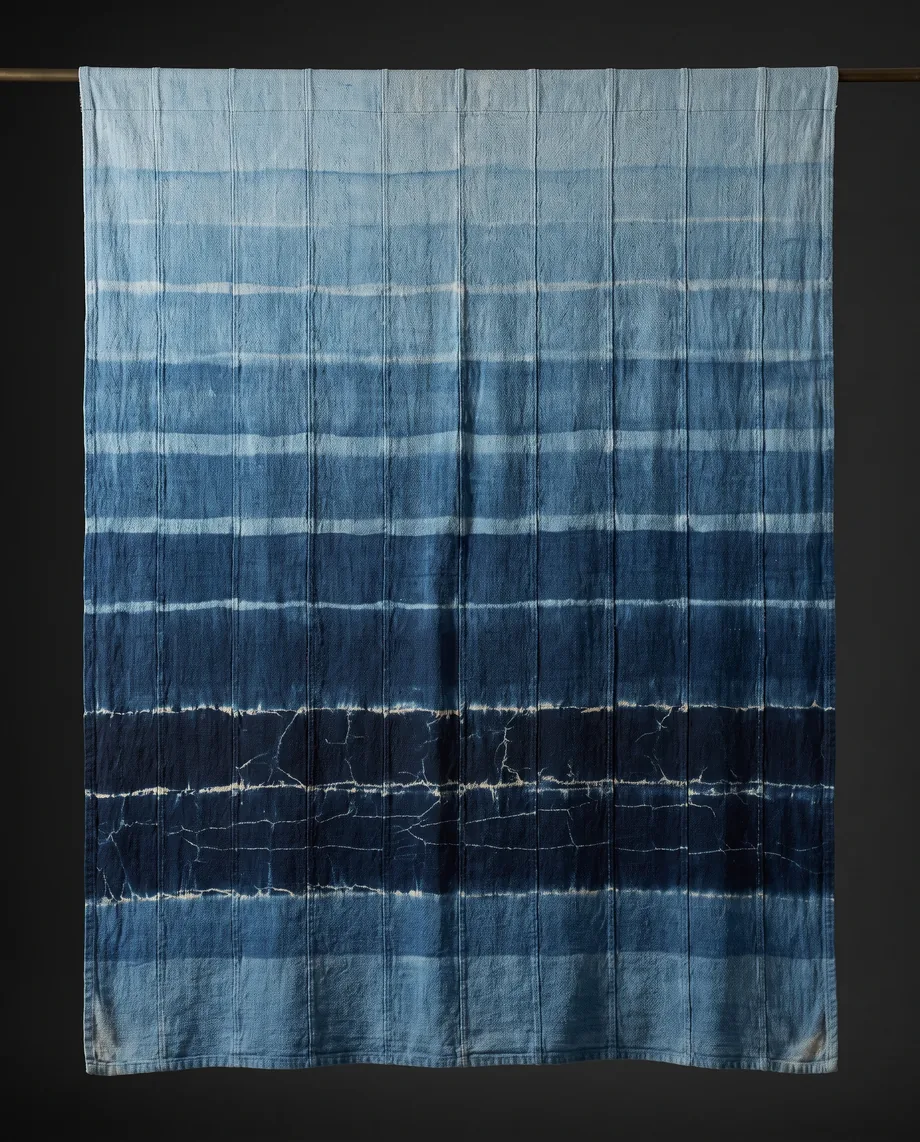
MF-005
404 × 158 cm
Stage 4.12
Bolaji Fagbemi · 2021
Cassava-paste resist and fermented indigo on hand-woven cotton strip cloth, stitched, on brass rod
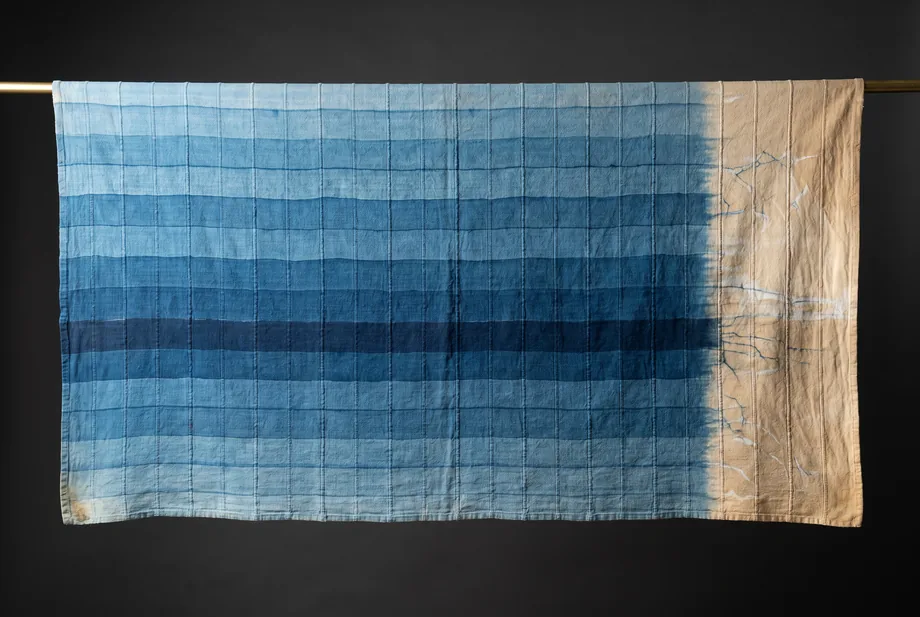
MF-006
168 × 384 cm
Rain Column Empty
Bolaji Fagbemi · 2022
Cassava-paste resist and fermented indigo on hand-woven cotton strip cloth, stitched, on brass rod