Hand 02
Dark Field Lacquer
Fumino Ozeki
Forty coats of black, and the image only appears when you move.
On record
- Life
- b. 1957, Kanazawa — lives in Wajima
- Origin
- Wajima, Noto Peninsula
- Medium
- Urushi lacquer, tin powder and hemp cloth ground over bentwood cypress
- School
- Dark Field Lacquer
- Works
- 02 in the collection
Influences
spectacle-lens grinding on cast-iron laps · raw urushi and its four-day cure · the cedar drying cabinet at seventy-eight percent · magnolia charcoal · tin oxide polishing slurry · night fog on Wajima harbour
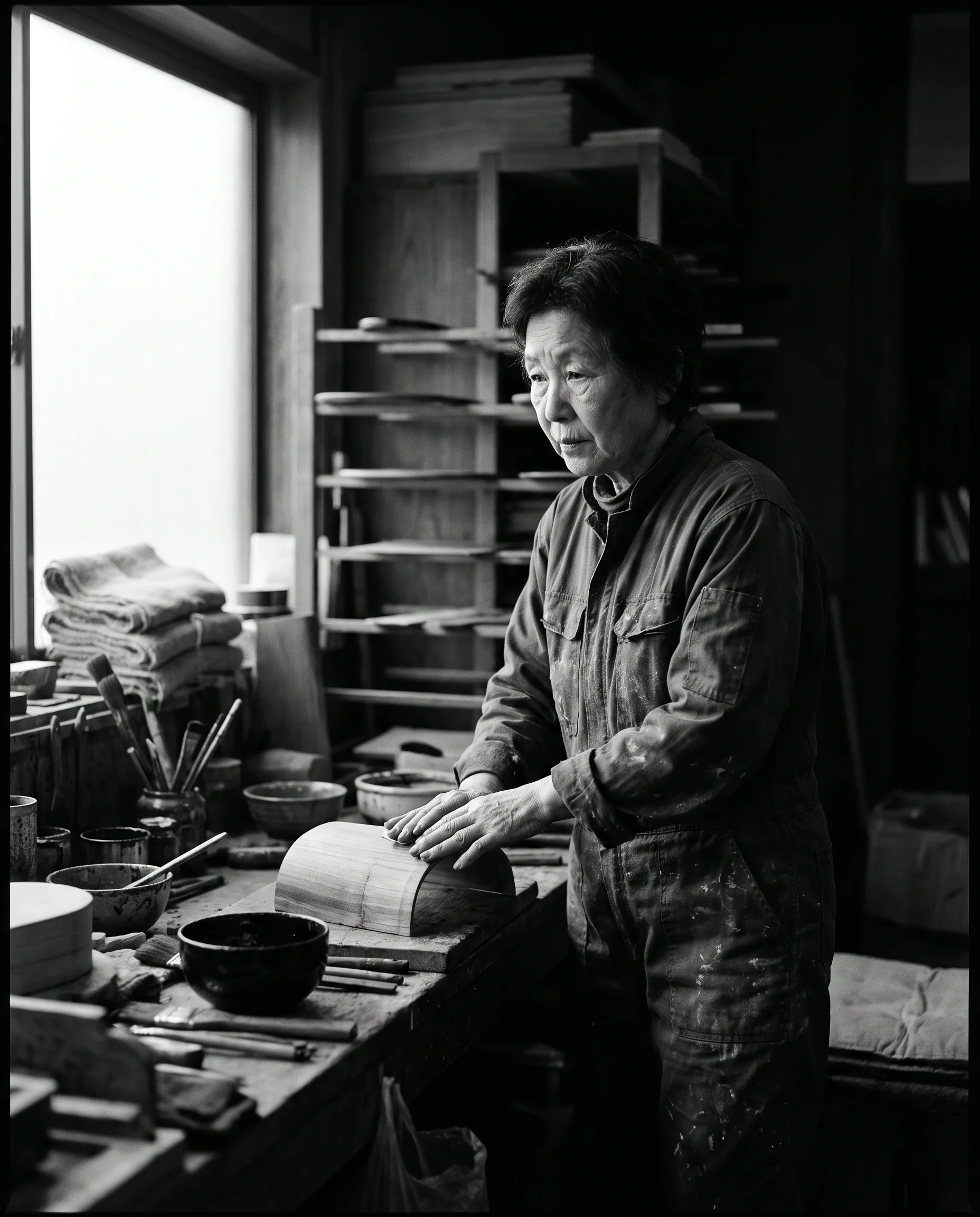
Ozeki left school at eighteen and spent seven years grinding spectacle lenses in an optical shop on Katamachi, roughing blanks on a cast-iron lap and finishing them with tin oxide slurry on her palm. At twenty-six a lacquer finisher in Wajima hired her because her hands already knew how to feel a curve going wrong. She never learned to make bowls, and does not intend to. What she took from the optical shop is the conviction that a surface is a lens, and that an image lives under it rather than on it.
Each panel begins as bentwood cypress wrapped in hemp cloth set in rice paste, over a ground of burnt clay and raw urushi. Then thirty-eight to forty-four coats, each wiped on, dried four days in a cedar cabinet held at seventy-eight percent humidity, and cut back with magnolia charcoal. Tin powder is dusted into the eleventh coat and again into the thirty-first, so the image sits at two depths behind amber-black. In 2004 a borrowed dehumidifier ran all night, the cabinet fell to forty percent, the coats never cured, and she scraped three years back to the hemp.
Twelve panels exist. She permits one photograph per work, made in the gallery under a single source at 2700 kelvin, because a flat reproduction shows the top of the lacquer and none of the tin. She will not make trays, bowls, boxes or anything with a use, and has returned two commissions that asked for gold. She will not touch a buffing wheel; the last polish is her thumb and tin oxide slurry, eleven days of it, and she counts the days out loud to visitors who ask why the work costs what it costs.
“Black is not a colour here, it is a depth of water. If you stand still you see nothing, which is correct, because the work is finished by your neck and not by me. I am told this is difficult. I ground lenses for seven years for people who could not see, so I know what difficult is.”
The hand, as specified
- Substrate
- A near-black lacquer mirror, flawless and slightly convex, in which a pale image surfaces only at grazing angles. Forms are tin grey clouds and long tide-like bands, soft-edged, low in contrast, dissolving where the lacquer thickens; amber over black glows where a coat has been polished thin, and bengara red shows as a hairline at the panel's edge. No craquelure, no visible brushwork, only the faint circular ghost of thumb polishing. A single warm 2700 kelvin source reads as one elongated highlight down the right third. Composition centres on a horizontal division low in the field, abstraction almost total. Upright rectangular panels, roughly 45 by 60 centimetres, edges wrapped in hemp and blacked.
Selected exhibitions
- 2011Two Depths of GreySokei Lacquer Hall, Kanazawa
- 2019You Finish It By MovingHakusan Kura Annex
- 2023One Photograph Per WorkMOONFLUX
In the collection
02 works
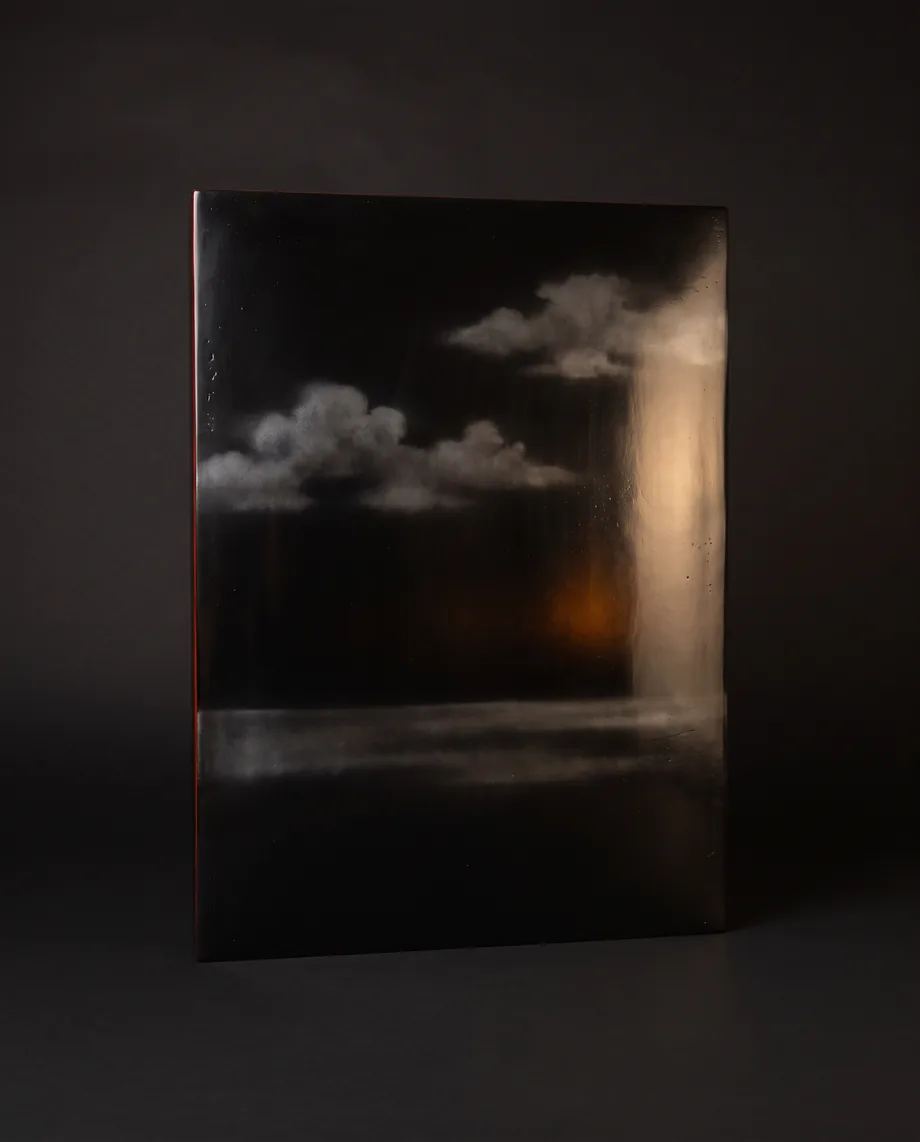
MF-003
60 × 45 cm
Seventy-Eight Percent
Fumino Ozeki · 2012
Raw urushi lacquer, tin powder, hemp cloth and burnt-clay ground over bentwood cypress; bengara red edge; thumb-polished with tin oxide slurry
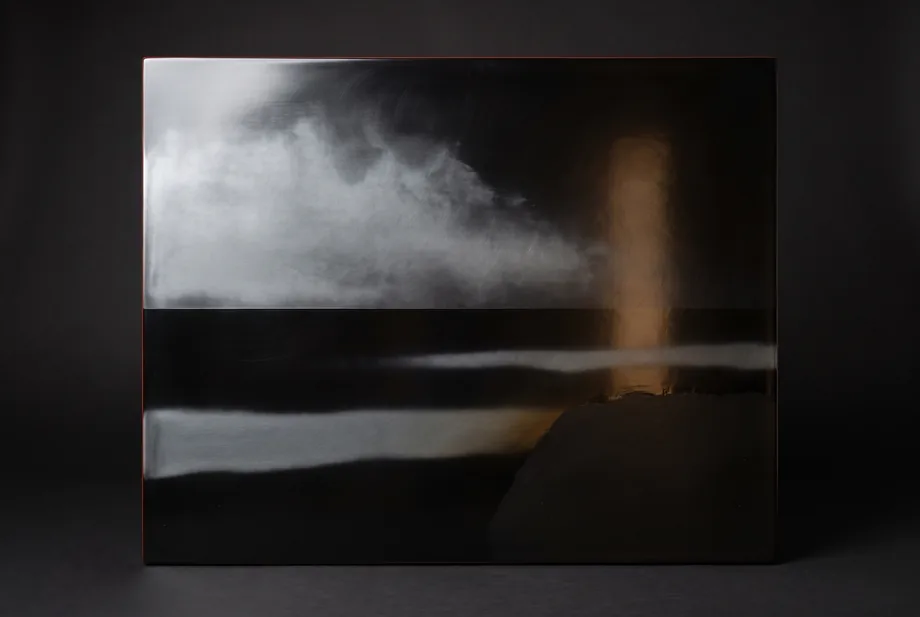
MF-004
44 × 88 cm
Breakwater, February
Fumino Ozeki · 2016
Raw urushi lacquer, tin powder, hemp cloth and burnt-clay ground over bentwood cypress; bengara red edge; thumb-polished with tin oxide slurry