Hand 01
Bus-Shelter Secco School
Guram Abashvili
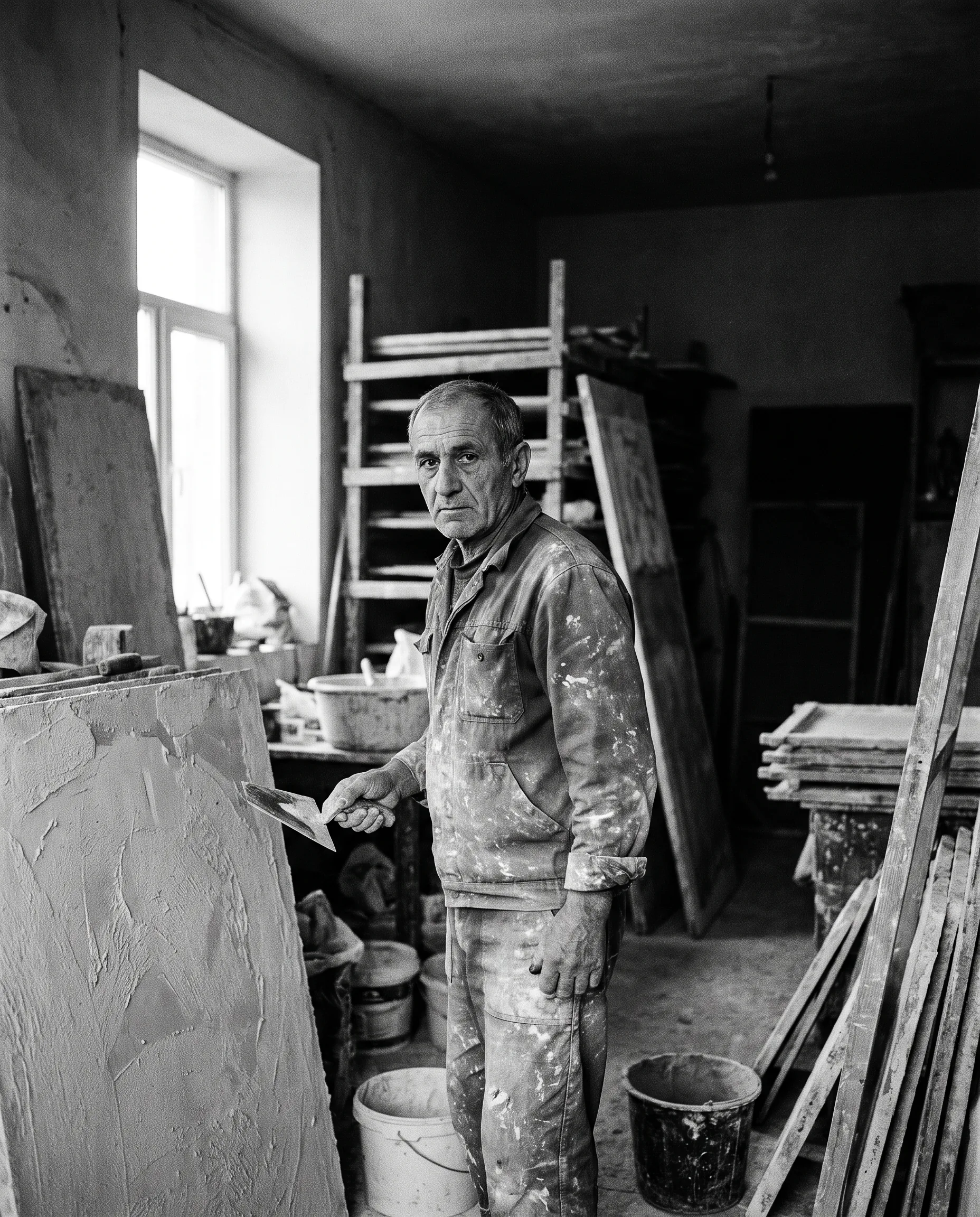
He painted the walls people waited against, then took the walls home.
On record
- Life
- b. 1941, Tbilisi — d. 2019, Tbilisi
- Origin
- Tbilisi
- Medium
- Lime plaster and casein secco on salvaged cement-board panels
- School
- Bus-Shelter Secco School
- Works
- 02 in the collection
Influences
the sulphur steam of Abanotubani · cobalt enamel on Soviet bus-shelter signage · three-year-old lime putty · provincial Georgian donor portraits · tram timetables · the dry January wind off the Mtkvari
Abashvili grew up in a two-room flat above a tram depot in Didube and joined the municipal restoration roster at twenty-three. For twenty-six years his job was the ceiling of a sulphur bathhouse in Abanotubani, patching lime plaster over steam that never stopped rising. Slaked lime took the whorls off his right thumb by 1971, and he signed everything afterwards with a left thumbprint pressed into the margin. On Sundays he drove the Kakheti highway with a crowbar and stripped cement-board panels from condemned bus shelters, which is the support for every painting he made.
He aged lime putty three years in a zinc washtub under the stairs, trowelled it thin over the cement board, then let it go hard before painting. The colour is casein, curd begged from a neighbour's goat, ground with ochre and bone black on a sheet of window glass. Until 1979 he worked true fresco and the panels shed: Tbilisi winters dried the plaster before it could carbonate, and faces flaked off in dry chips he found in his shoes at night. The casein held. It also gave him the chalk bloom he wanted, which he pretended was an accident.
Fourteen panels are in the collection, none varnished, because he said varnish makes a wall look like a plate. He refused to paint anyone looking out at the viewer, on the grounds that people waiting for a bus look at the road. He refused enlargements, telling a Munich dealer that a bus shelter is two hundred and forty centimetres and that is the end of the argument. He kept his prices at the level of a good used refrigerator until 2014, raised them once, badly, and complained about it for five years.
“I paint the wall people lean on while they wait, and then I take the wall. Nobody misses a bus shelter. The lime cost me a thumb and gave me a surface, so we are even. When collectors ask what the panels mean, I tell them they mean the number 47 is late.”
The hand, as specified
- Substrate
- Matte casein on hard lime plaster, entirely without gloss, the paint scrubbed on thin so the plaster's aggregate grit reads through every passage. Marks are dry-brush and short, edges chalky and slightly frayed, never cut clean. Figures stand in three-quarter view or turned away, simplified to flat silhouettes in lime white, raw ochre and bone black, with hands modelled more carefully than heads and one flat band of enamel cobalt behind them. Light is cool overcast daylight from upper left, around 5000 kelvin, casting no shadows and permitting no highlights. Compositions are upright and narrow, roughly 240 by 90 centimetres, figures set low with empty plaster above. Hairline craquelure throughout, chipped corners exposing grey cement board.
Selected exhibitions
- 1983The 47 Is LateKolkheti Hall, Tbilisi
- 2001Nobody Misses a Bus ShelterMarneuli Plaster Works
- 2020Left Thumb, Right MarginMOONFLUX
In the collection
02 works
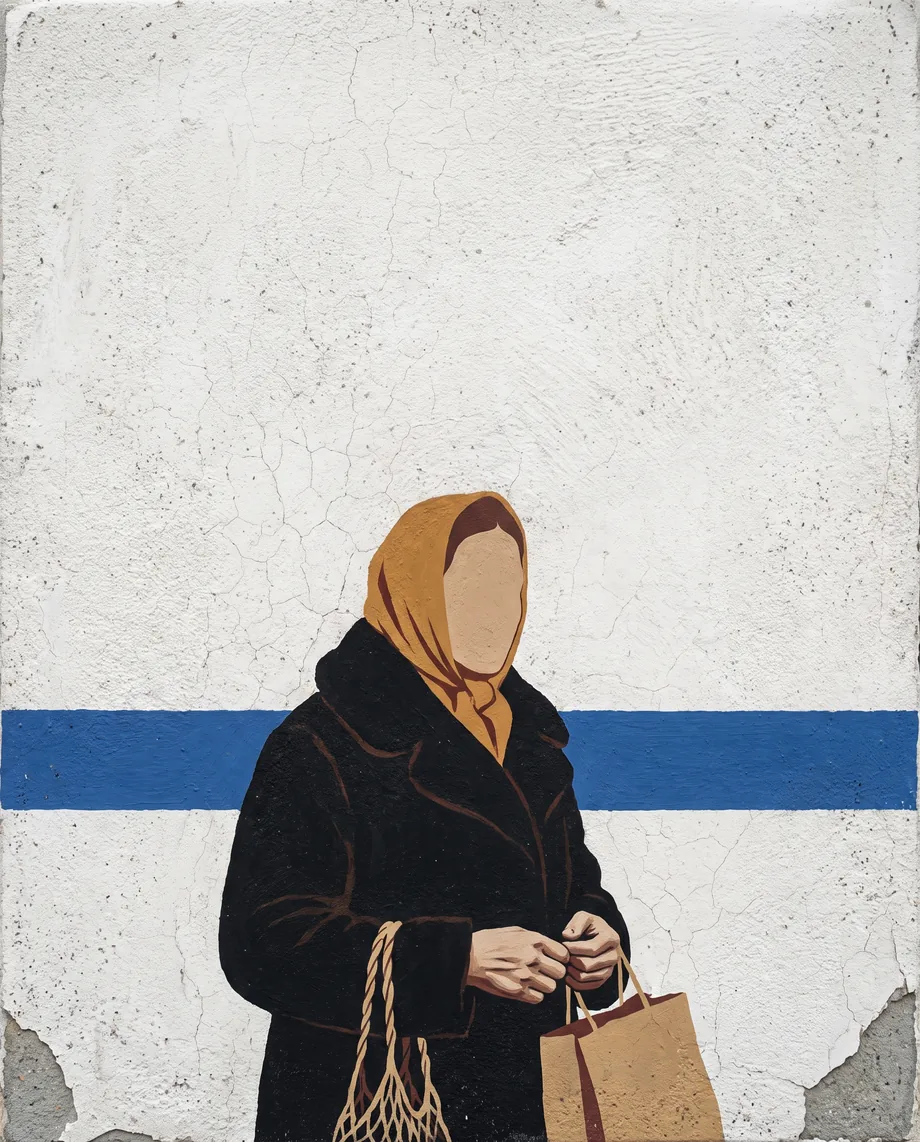
MF-001
241 × 88 cm
Two Bags
Guram Abashvili · 1986
Casein tempera on three-year-slaked lime plaster over salvaged cement-board bus-shelter panel, unvarnished
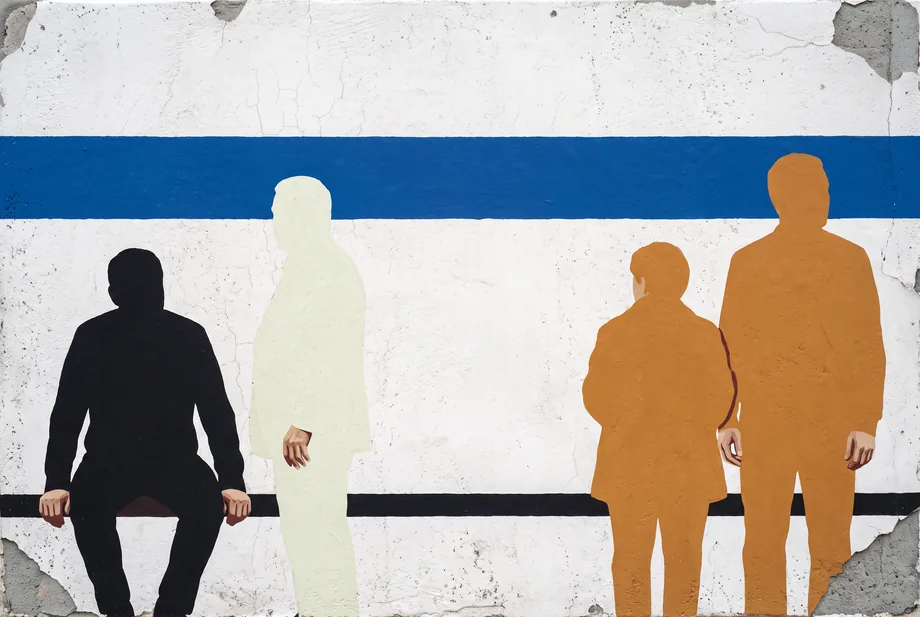
MF-002
89 × 236 cm
Four Waiting
Guram Abashvili · 1991
Casein tempera on three-year-slaked lime plaster over salvaged cement-board bus-shelter panel, hung on its long side, unvarnished